
How To Alienate Your Customers

I’ve always known that Apple was a philosophically ‘liberal’ organization. Steve Jobs, Apple’s CEO, is decidedly left-wing in his political views, as are many of the other company leaders. There is nothing inherently wrong with that. I have no qualms about buying a product from a company or person with whom I have moral or political disagreements.

Steve Jobs, as an individual, can do whatever he wants with all the money he has made at the helms of Apple and Pixar. But I have an objection to the company putting its money toward political or moral causes—whether I agree or disagree with those causes—except when the company’s core business is directly impacted by government policy. In other words, I’m fine with Chrysler lobbying for or against vehicular safety laws. I’m fine with Google supporting or opposing Net Neutrality legislation. I’m not fine with Apple actively opposing California’s Proposition 8, which would prohibit gay marriage in the state.

I oppose the redefinition of marriage, and I especially oppose it when (like in California) the right to gay marriage is unconstitutionally fabricated by the courts rather than legally redefined by the legislature. But whether I agree or, as in this case, disagree with the political stance taken by a business, I find the idea of businesses engaging in public advocacy on controversial social issues distasteful on either side.

I’m not one to pronounce that I will ‘never buy Apple products again,’ but this is certainly an issue I will have to keep in mind when I consider my next computer purchase. I don’t want my computer purchase money going to political causes, especially ones with which I disagree, and I will have to consider whether Apple’s compelling products are worth more to me than the risk of my dollars potentially working against my beliefs.

Update 10/27/2008: It is worth noting that another major tech firm, Google, also publicly opposes California’s Prop. 8. I am less concerned in Google’s case, since very few individuals ever actually pay Google for anything (they get their money from businesses) and it is a less ‘personal’ affront. I am not directly giving money to a cause I disagree with by using Google services; I am when I buy Apple products.
Understanding Polling

The Associated Press has put out a very interesting piece explaining (in limited detail) how political polls are done and why they can produce wildly differing results. In this election, the variation is pretty impressive. In the last week, a Pew Research poll showed Senator Barack Obama (D-IL) ahead of Senator John McCain (R-AZ) by 14 points. An AP poll showed the two candidates tied—a statistically insignificant 1 point lead for Obama.

The article, however, misses some important bits. For a long time pollsters did not call cell phones, which excluded those of us (like me) who don’t have land-lines entirely. Some polling organizations have begun including cellular customers, but there are still classes of people—introverts (like me) who don’t answer calls from numbers we don’t recognize, for example—that get excluded. Do these kinds of oversights affect the outcomes of the polls? Maybe. Maybe not. It’s hard to say whether introverts tend toward a particular candidate or not, especially since we don’t have much poll data on that ;-).

A million things can affect these polls. What time of day did they call people? People of different financial means tend to work different hours. Calls at dinner time might be ignored by families who eat dinner together. How were questions worded? They also (as the article explains) have to perform statistical adjustments for who is ‘likely’ to vote, but that can shift every year. For example, some pollsters are skewing the weighting for the African American vote higher this year on expectations that black turnout will be higher than in past years. In reality, these weightings are an educated guess that could easily be either right-on, underestimated, or overestimated.

All-in-all, one poll matters: the vote in November. These other ones are interesting, but they can be wrong. Don’t forget, everybody thought Governor Howard Dean (D-VT) would win the Democratic nomination in 2004 based on polls, but Senator John Kerry (D-MA) trounced him.

The Media’s Obama Love Affair

If you haven’t noticed what a recent Project for Excellence in Journalism report found, you haven’t been paying attention. Over the last six weeks or so, media coverage of Senator Barack Obama (D-IL) has been 36 percent positive, 35 percent neutral/mixed, and 29 percent negative. During the same period, media coverage of Senator John McCain (R-AZ) was 15 percent positive, 28 percent neutral/mixed, and an incredible 57 percent negative.

I have no problem with people in the media liking Obama, nor do I have any problem with inevitable media bias, but I wish the ‘MSM’ would at least try to have a semblance of journalistic integrity and balance. Their love affair with Obama would be comical in a vacuum, but the media plays a big part of forming many peoples’ opinions of these candidates. Thus, the media has a responsibility—morally, not legally—to portray both candidates dispassionately and as fairly as possible.

“It’s the Economy, Stupid”

It is these words, according to many pundits, that won the election for President Bill Clinton (D) over incumbent President George Bush [Sr.] (R) in 1992: “It’s the economy, stupid“. Bush enjoyed very high approval ratings during the first Gulf War, but as the war came to a close and the economy entered a recession the voters turned toward the candidate of ‘change’.

Bill Clinton, all-in-all, didn’t change much with the economy. The economy usually does its own thing and the government is best-advised to butt-out, which it has generally done through the last several Republican and Democratic administrations. In fact, by most independent analysis, federal economic policy hasn’t changed very much since President Ronald Reagan (R) took office in 1981. But the erroneous perception that Clinton would ‘fix’ the country’s economic woes turned the tide in his favor, and the perception that Bush would leave things ‘broken’ doomed his campaign.

Senator John McCain (R-AZ) is now running the risk of following in Bush [Sr.]’s footsteps. As the representative of the incumbent party, McCain has an uphill climb in a time of economic weakness. He accurately paints Senator Barack Obama (D-IL) as a tax-and-spend liberal, but ultimately McCain has not differentiated his economic plan from Obama’s. In fact, when they squabble over the nuances of each-others’ plans, I’m struck by how similar they are. Yes, I believe McCain presents a better plan. Yes, given Obama’s inclination toward tax increases and big government, I doubt his promised tax cuts will ever actually be implemented (or, if they are, I doubt they will last very long).

But when both candidates voted a resounding ‘yes’ on an ill-advised 700 billion dollar bailout, I have a hard time identifying which candidate is the fiscal conservative. When both present new big-ticket bailout and government expansion plans for mortgages or health insurance or whatever else, I have a hard time figuring out which one is opposed to socialism.

I’m convinced that most Americans want a smaller government that interferes less with our economy and our lives. This is a classical conservative value that the Republican Party has abandoned under President George W. Bush (R) and the Democratic Party never believed in in the first place. McCain needs to champion these values to excite his own party’s ‘base’ and win the support of moderates who are frustrated with Washington’s fiscal policy. But time is running out, and fiscal conservative voters are rightly suspicious of McCain in light of his very public support for economic interventionism. Put us at ease, Senator McCain, and do it fast. If you don’t, you are very likely to lose this election.

Command Line Reminiscence

I’ve mentioned before that my first serious computer experience was on an old IBM PC-AT 286 running MS-DOS 5.2. I became quite capable of instructing that machine from the spartan DOS prompt, and every once in a while I long for the days of text-based interfaces and obscure commands (it’s a nerd thing).

The good news is that every major modern operating system can still be controlled, to varying degrees, from command line interfaces when you long for a retro experience. In Windows, you go to Start > Run and run the command ‘cmd’ to bring up a command prompt that works very, very similarly to the long-defunct MS-DOS. Mac OS X has a program called ‘Terminal’ in its Utilities folder that brings up a UNIX command prompt. In Linux it varies by distribution and interface, but there is always a ‘Terminal’ listed somewhere in its menus.

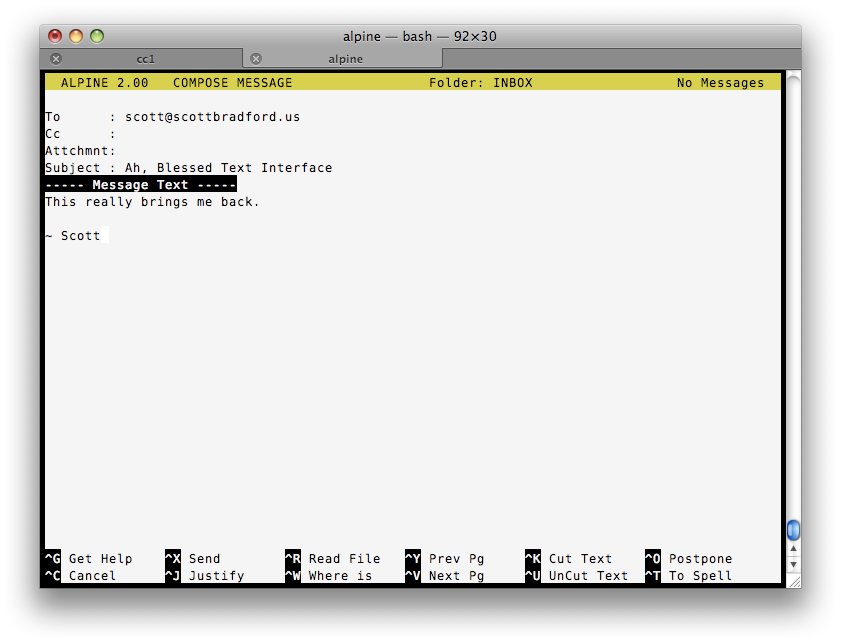
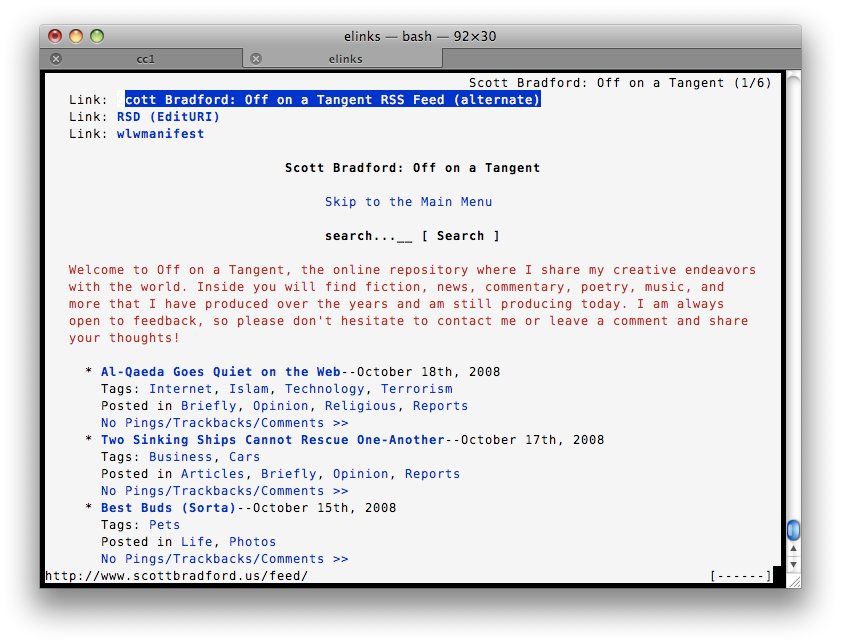
In the UNIX/Linux world (which includes Mac OS X, especially if you install MacPorts), there are a couple essential programs that allow you to live in the command line world for a while. ELinks is a capable text-based web browser. Alpine is a text-based email program (loosely related to the somewhat well-known PINE system, which has been discontinued). There’s also the Nano text editor (as well as the much more difficult, though immensely powerful, Vim and Emacs editors).

If you’re like me, and you want to spend a couple hours getting your work done in a text-based environment, it can be done. All I need to really put me ‘over the top’ would be a text-based office suite.

Scott Bradford is a writer and technologist who has been putting his opinions online since 1995. He believes in three inviolable human rights: life, liberty, and property. He is a Catholic Christian who worships the trinitarian God described in the Nicene Creed. Scott is a husband, nerd, pet lover, and AMC/Jeep enthusiast with a B.S. degree in public administration from George Mason University.