
Is Microsoft Getting It?

I’ve spoken before about my disdain for Microsoft’s flagship operating system, Windows 6.0 (Vista), before. Vista took nearly six years to develop, and the only things it really added over its Windows 5.1 (XP) predecessor were some eye candy and things that annoy the users—you know, things like the constant UAC prompt, bugs, and incompatibilities. Most of the groundbreaking promised features, like the WinFS file system and such (the things that get nerds happy) were scrapped from the system entirely. Apparently six years isn’t long enough to produce a compelling update from either the technical or usability standpoint.

Real-world Windows 6.0 (Vista) experiences are a mixed bag. Roughly 50 percent of people I know that run Vista daily are happy with it and have had minimal problems. The remaining 50 percent, however, have had problems worse than any previous version of Windows had ever given them. Some of those people worked through these problems, installing service packs and engaging in earnest troubleshooting, and finally became happy Vista users. Most, however, upgraded back to Windows 5.1 (XP), switched to Mac, or switched to Ubuntu Linux happily.

Has Microsoft learned from their mistakes? It looks like they might have. The next version of Windows, which will return to the venerable tradition of logical naming, might actually be a compelling and worthwhile update called Windows 7. (Of course, for reasons I don’t understand, Windows 7 will be code-versioned as 6.1—come on Microsoft, you’re so close to fixing the versioning/naming insanity that you started with Windows 95, just go all the way and make it Windows 7 everywhere!)

What will Windows 7 offer? Well, the promise is that it will be less annoying (fewer UAC prompts), more stable, usable on a wider variety of hardware (even underpowered ‘netbooks’), and incorporate many usability features that Apple and various Linux implementations have had for years. In light of Microsoft’s propensity to over-promise and under-deliver, I’ll believe it when I see it. But the screenshots sure look great, and I’m cautiously optimistic that the giant from Redmond has finally awoken.

Does this mean that I might be switching back to Windows? Don’t bet on it. But it benefits everybody when the competition heats up, so improvements in Windows will drive improvements on all other platforms as well.

Two Sinking Ships Want a Bailout to Rescue One Another

Like I said a couple weeks ago, two sinking ships cannot rescue one another. The proverbial sinking ships, General Motors (GM) and Chrysler, seem to have finally come to this conclusion in the course of their earnest and horribly misguided merger talks. The problem is that, instead of quietly sulking away into Chapter 11 bankruptcy for one or both automakers, they now want to enlist Mommy Government’s help (and thus, your help) in sealing the deal. That’s right, GM and Cerberus Capital Management (Chrysler’s owner) want the United States government to hand them 10 billion dollars so that they can merge.

I am absolutely aghast.

What would the government and—by extension—you and I get in return? Well, 3 billion dollars of that money would buy a chunk of GM/Chrysler’s ‘equity’. Of course, when the combined firm goes under anyway because of the UAW, mismanagement, and other problems that ‘equity’ will be worthless. Another 3 billion dollars would go to taking over GM and Chrysler pension obligations, and the rest would apparently just be free money. This is not a gamble investors will take, so why should the government take it?

Not to mention that it was only a month ago that the U.S. government gave these same automakers 25 billion dollars in loan guarantees—for a running total of 35 billion dollars that you and I are on the hook for if the American auto industry bankrupts itself. Anybody else feel a bit ill?

Update: Hours after I wrote this, I came upon an opinion piece by Steven Pearlstein in the Washington Post who says the same thing, but with a well thought-out alternative solution. Kudos to Pearlstein; I sure hope GM, Chrysler, and Congress are listening.

Update 11/3/2008: The International Herald Tribune reports that the Bush Administration will not be negotiating this new 10 billion dollar bailout with GM. Finally, the government makes a smart economic decision.

Senator Ted Stevens Found Guilty

Senator Ted Stevens (R-AK) has been found guilty on seven counts of making false statements for failing to disclose gifts he received from VECO, an Alaskan oil services company, on Senate disclosure forms. Stevens, the longest-serving Republican in the Senate, was indicted in July and was the first sitting senator to be indicted since 1993. This marks the most recent incident in a series of corruption and nepotism charges that have dogged Alaska state politicians in recent years.

Stevens is currently seeking reelection for a seventh term in the Senate, and is facing a tough race against Mark Begich (D). Because it is within 45 days of the election, the Republican Party cannot remove Stevens from the ballot. Stevens is vowing to continue his campaign and fight the conviction, presumably through appeal.

Editorial Note: My wife Melissa is an employee of CH2M Hill, which acquired VECO in September 2007. The alleged incidents occurred before the acquisition, and Melissa works in a different operating division of the company.

Media’s Presidential Bias and Decline

A refreshing and fascinating column appeared today on ABCNews.com from Michael Malone, one of the few legitimate newsmen still present in the journalism industry, about the unapologetic and overwhelming media bias in this presidential election in the context of a declining industry. He points the finger, primarily, at media editors—perhaps rightfully so—but I think he goes too easy on the modern journalist and the modern journalism school.

I majored in Public Administration, but my interest in journalism led me to add an Electronic Journalism minor. Two things struck me about George Mason University’s journalism department: First, the vast majority of my classmates—people who wanted a career in journalism—didn’t actually watch the news, pay attention to world events, or know who major world leaders were. Second, the professors were extraordinarily biased against conservative media (Fox News, Wall St. Journal, etc.) and toward liberal media (New York Times, CNN, etc.) and did not hesitate to express those views and expect you to agree with them. I had one professor tell me, with a straight face, that Al Jazeera was a more fair and even-handed television news network than Fox News Channel.

Malone is part of a dying breed—journalists who see it as their responsibility to ask the hard questions of everybody, and present their answers with as little bias as possible. Malone and I agree that bias is inevitable, and human beings will always subconsciously inject their biases into the things they say and write even when they try not to, but that the recent media Obama-fest (of which he gives many examples) is unforgivable. His column is well worth the read, regardless of your political views, because a dishonest media will ultimately hurt everybody.

Growing the Arsenal

Back in June, Melissa and I made our first firearm purchase when we picked up a Smith & Wesson ‘Model 620’ .357/.38Spc. 7-shot revolver. The main reason we went for a revolver over a semi-automatic handgun was that Melissa was more comfortable with revolvers, and we wanted a home defense weapon that both of us were equally comfortable with. Also, revolvers require less maintenance. Woefully neglected revolvers that have sat in drawers unused and uncleaned for years-upon-years generally still go ‘bang’ when you pick them up and pull the trigger, and even if they don’t fire the first time clearing a misfire in an emergency is as easy as pulling the trigger again.

I, however, was more interested in a semi-automatic. Yes, they need a bit more care. Yes, clearing a misfire in an emergency requires a bit more effort (forcefully pulling back the slide and releasing it, basically). But in return you get a firearm that, in roughly the same sized package, can pack 12-17 rounds as opposed to a revolver’s 5-7 and can fire those rounds quicker. The difference is most pronounced when you look at compact weapons for concealed-carry, where the semi-automatics are narrower (easier to conceal) AND pack at least twice the ammo capacity (5 for compact revolvers vs. 10+ for compact semi-autos). This will be more important to me later, after I get a concealed carry permit.

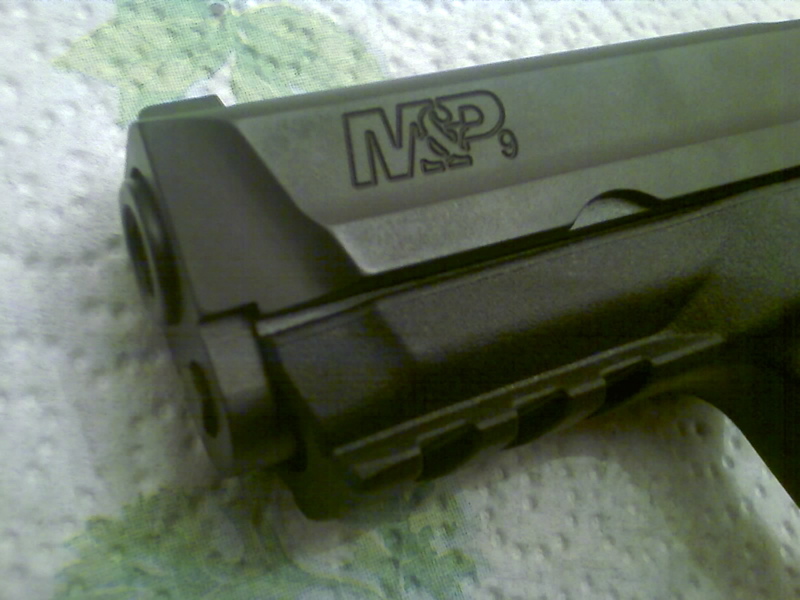
Anyway, for my upcoming birthday Melissa took me to Virginia Arms in Manassas and we picked up a Smith & Wesson M&P 9. This will allow me to get real good and familiar with semi-automatics before eventually getting a compact, concealed carry weapon. Plus, now we can both be armed if necessary.

The gun (which comes with two 17-round magazines) was designed by Smith & Wesson to compete with Glock for the police market. Most of the specs between the M&P and the Glock 17 (my second-choice) are nearly identical, but the made-in-America M&P won on ‘creature comforts’. It comes with three different-sized back-straps which allow you to easily resize the grip to fit your hand. Most importantly for me, it is equipped with an ambidextrous slide lock and reversible magazine release. If you’re right-handed these things don’t matter—all guns are made for you in their default configuration. If you’re a lefty, this means you can lock the slide back and release the magazine just like everybody else without performing impressive arm/finger contortions. It’s a miracle.

I’m hoping to take it to the range and break it in tomorrow or, worst case, some time this coming week.

Scott Bradford is a writer and technologist who has been putting his opinions online since 1995. He believes in three inviolable human rights: life, liberty, and property. He is a Catholic Christian who worships the trinitarian God described in the Nicene Creed. Scott is a husband, nerd, pet lover, and AMC/Jeep enthusiast with a B.S. degree in public administration from George Mason University.