
War for South Ossetia . . . or the Whole of Georgia?

I haven’t written about the War for South Ossetia yet since, initially, the confliict seemed to be pretty minor and inconsequential in the grand scheme of things. South Ossetia is, technically, part of Georgia (the country, not the U.S. state) though it declared independence in the early 1990s and has essentially operated independently since then, though no U.N. members have recognized South Ossetia as independent.

Neighboring North Ossetia is part of Russia, and Russia has (unofficially) supported South Ossetia and opposed Georgian influence in the region. The situation between Russia and Georgia over South Ossetia began to spiral out of control last week. Georgia, claiming that seperatists in South Ossetia had initiated violence, sent troops into South Ossetia on Thursday. With surprising speed, Russian military forces amassed on the border and entered South Ossetia pushing Georgian troops out of the breakaway province.

If it had ended there, it would have been a non-story. But Russian forces continue to press into Georgia proper and bomb Georgian targets, and the Russian government has refused to accept a cease fire offered by Georgia. Russia has publicly issued an ultimatum to the Georgian government, demanding their complete withdrawal from South Ossetia and binding agreement to never reenter South Ossetia with military forces.

Some are beginning to suspect that Russia’s intentions may extend beyond securing South Ossetia to annexation of the province, and perhaps the entirety of Georgia, as Russian forces continue to invade sovereign Georgian territory without provocation.
A Bike for Leaving the Beaten Path

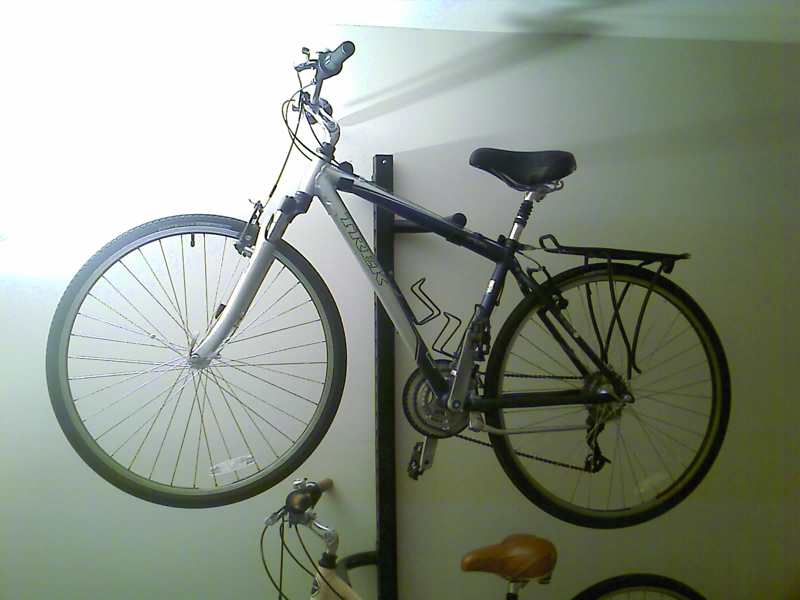
So last fall I bought a Trek 7100 hybrid bicycle (right), which has served me very, very well over the last year or so. I’ve put quite a few miles on that bike and have enjoyed [pretty much] each one of them. There’s just one small problem.

The Trek is a hybrid, which means it has elements of a mountain bike and elements of a road bike. Its geometry, tuning, and tires (300c) are all designed for traveling primarily on pavement—roads and paved trails—and very, very limited off-road use when absolutely necessary. That makes it similar to a road bike. The main difference between a ‘hybrid’ and a road bike is that the general shape is more like a mountain bike and you sit more upright—helpful if you have back problems, like my scoliosis. That makes it slower than a road bike, but much more comfortable.

Anyway, you don’t want to be riding very far off-pavement on a hybrid with its smooth, narrow tires and comfort-oriented geometry. That rules out some of the major unpaved bike trails in the area: many segments of the Cross County Trail and the entire C&O Canal Towpath are two prime examples.

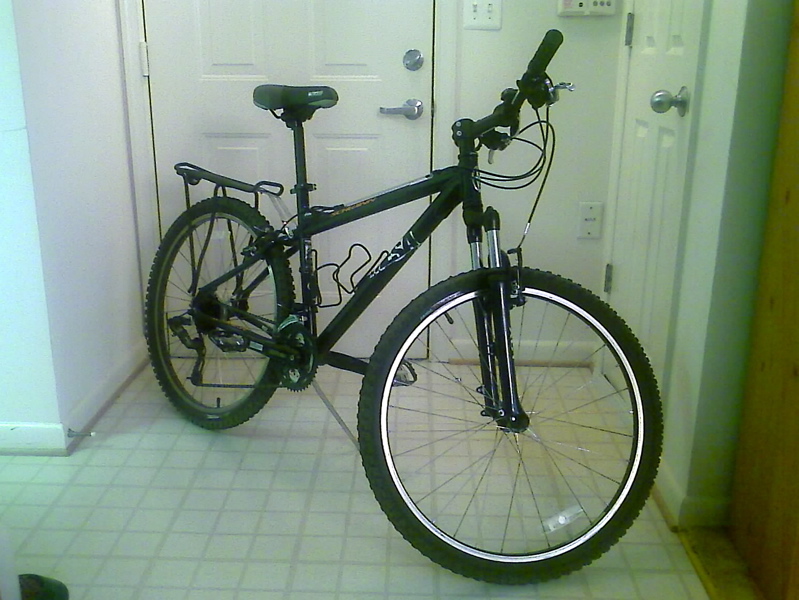
So yesterday I bought a relatively inexpensive low-end mountain bike—the Schwinn Mesa (right)—for when I feel like a shorter, rougher ride than the on-trail excursions I’ve been doing on my Trek. I rode about 5 miles on the Cross County Trail yesterday (the northernmost segment) successfully, though my mountain biking reflexes are a little rusty and I did manage to take one impressive spill (you should see the colorful bruise on my knee). All-in-all, it was fun. I’ll probably aim for about 70 percent road/trail riding on my Trek, and about 30 percent off-road on my Schwinn.

I also figure the Schwinn, being quite a bit less expensive than the Trek, can be my project bike for learning how to do all my hard-core bicycle maintenance and make sure it works before touching the Trek ;-). If I can avoid taking either to the bike shops, I figure it will cover its own cost within a year or two of heavy riding and regular maintenance/repairs.

Prince George’s County SS Brigade

I am a big supporter of law enforcement, and I have the absolute utmost of respect for most police officers. They do a difficult and usually-thankless job. I’ve had interaction with various police officers and departments in my life—after reporting stolen property (in high school), being pulled over for speeding (twice in the early 2000s), getting ticketed for being in a park after hours (2001), after one car accident (2002), when I’ve stuck around after witnessing various accidents, while they canvassed my neighborhood during an investigation (2007), while they were providing event security, and socially. These officers have all been kind, fair, and professional.

I’ve had two unpleasant experiences. One, involving Fairfax County Police Ofc. Graham Buck, I’ve written about extensively before. The other, involving Fairfax County Police Ofc. George Lopez, I characterize as more minor and have not written about before. While driving through the Clifton Day festival at extremely low speed to go pick up Melissa and her art displays, Ofc. Lopez stopped me and literally got in my face and yelled at me because, apparently, his vague hand gesture I had been trying to decipher meant ‘stop the car now’ and I, busy trying to decipher it, hadn’t stopped right away. (I did file a complaint since Ofc. Lopez was extraordinarily rude, and the Internal Affairs Bureau found that he had not broken any law or department policy. That does not necessarily mean he wasn’t informally reprimanded by his superiors, but if he was it was ‘off the record’.)

But neither of these incidents compares to the egregious abuse of power committed recently by the Prince George’s County Police in Maryland more reminiscent of the Nazi SS than an American police force.

The Kaminsky Bug In-Depth

I’ve written a couple entries over the past weeks regarding a critical bug in the Domain Name System (DNS)—one of the core engines behind a functioning, secure Internet. This bug, if exploited, would have allowed attackers to redirect legitimate Internet traffic to malicious sites and could have destabilized the entire web. Dan Kaminsky, the security researcher who discovered the bug, worked with major DNS software maintainers and various major web sites on the web to put out an unprecedented multi-vendor patch, and many system administrators around the world deserve commendation for testing and applying those patches.

If you’ve been waiting for details (as I have), they’re now available in a downloadable PowerPoint presentation over at Dan Kaminsky’s web site. The bug is as bad (and perhaps even worse) than all the chatter and speculation led us to believe.

Over on Kaminsky’s site you can also check your DNS servers to see if they are secured (which is likely your ISP’s responisibility). Do your part too: run Windows Update (Windows), Software Update (Mac), or apt-get/yum/Update Manager/Pup/whatever (Linux) to make sure your system is up-to-date.

Mexico Commits An[other] Act of War

The Washington Times reports that members of the Mexican military crossed into Arizona on Sunday and held a U.S. Border Patrol agent at gunpoint before retreating to Mexico when U.S. reinforcements arrived. According to the National Border Patrol Council Local 2544, a union chapter representing Border Patrol agents, this kind of thing is a regular occurrence on our southern border:

Unfortunately, this sort of behavior by Mexican military personnel has been going on for years. They are never held accountable, and the United States government will undoubtedly brush this off as another case of “Oh well, they didn’t know they were in the United States.” A few years ago the Mexican military went a step further and put a .50 calibre rifle round through the rear window of a Border Patrol agent’s patrol vehicle south of Ajo. Nothing was ever done. Nobody was ever held accountable.

In other times, this kind of behavior—especially coupled with propensity of Mexican military personnel to assist in drug smuggling and border crossings by illegal immigrants—would be considered an act of war. I certainly don’t think that we should go to war with Mexico over border incursions in the middle of the desert, but we should certainly send some kind of formal, stern message to our neighbor to the south.

Mexican soldiers have no right to enter the United States, and even if they do so unintentionally (which is possible in the desert) they’d better make damn sure they know what country they’re in before holding anybody at gunpoint. The same goes for U.S. soldiers who might unintentionally cross into Mexico. Perhaps both countries should invest in some TomToms before we end up in the middle of a serious international incident.

Scott Bradford is a writer and technologist who has been putting his opinions online since 1995. He believes in three inviolable human rights: life, liberty, and property. He is a Catholic Christian who worships the trinitarian God described in the Nicene Creed. Scott is a husband, nerd, pet lover, and AMC/Jeep enthusiast with a B.S. degree in public administration from George Mason University.