
Partial Bank Nationalizations to Begin

As the 700 billion dollar economic bailout begins to take effect, it’s worth looking at what the government actually intends to do with that money. The first 250 billion dollars is about to enter the economic system, and the government—under the leadership of President George W. Bush’s (R) Treasury Secretary, Henry Paulson—is going to use much of it for a forced partial nationalization of our banking system.

The government can use the money for a number of things, including buying ‘bad debt’ from private banks (which was much of the initial intent). That’s socialist enough in nature for my tastes, but the government’s revised bailout allows it to make ‘equity investments’ in many private banks—perhaps hundreds of them. That will begin soon with 9 ‘top’ banks. We still don’t know how big each of these ‘equity investments’ will be, but let’s not speak in euphemisms. An ‘equity investment’ means you are buying part of the bank. Yes, the government of the United States will soon own parts—possibly large parts—of the U.S. banking system, and will offer those banks increased benefits and/or responsibilities in return (as compared to wholly-private banks).

The U.S. government has very limited authority under the Constitution for owning or managing banks. By ‘limited authority’ I mean it has absolutely no such authority whatsoever. The existence of the Federal Reserve is debatably Constitutional since the federal government does indeed have a right to produce money, though the Reserve arguably grossly oversteps that limited purpose, and that’s pretty much it. We are on the verge of one of the most blatantly unconstitutional acts of economic interventionism in U.S. history, and we as citizens must be mindful of this dangerous slide toward socialism.
Meet the Repo God

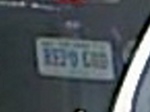
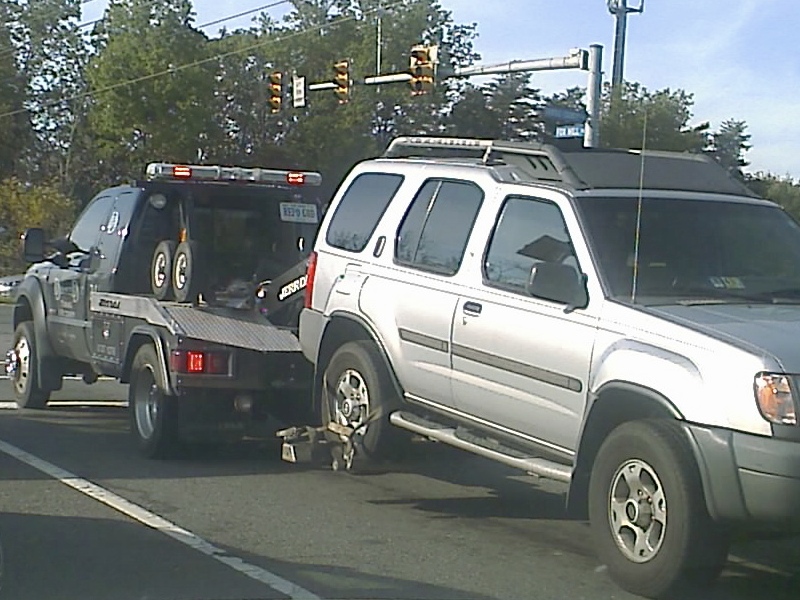
I was driving home the other day and saw a tow truck towing a Nissan Xterra, and I had to chuckle when I saw the tow truck’s license plate. Yes, ladies and gentlemen, you are looking at Virginia’s ‘REPO GOD’.

Unfortunately the photo quality isn’t too high, so I blew up the plate. It’s still not crystal clear, but take my word for it :-).

I’m pretty sure this is a repossession-in-progress too, since they’re likely not towing the Xterra correctly (its drive wheels are on the ground, and that’s usually a no-no) . . . that probably means it was a ‘hurry up and take it before the psuedo-owner notices and we’ll fix it later’ kind of deal.

How To Destroy the Economy

In the last month, the Dow Jones Industrial Average—a key indicator of U.S. economic health—has dropped more than 20 percent. The world markets are crashing, and pundits are already heralding this as the worst economic disaster since the Great Depression. President George W. Bush (R) and leaders of the Republican and Democratic parties would have you believe that they doing everything they can the head off an impending economic catastrophe.

But let’s step back for a minute and look at how we got here. The reality might be pretty surprising.

In the 1990s, we were riding high on the ‘dot-com boom’. Internet companies, many of which did not have rational business plans, were the darlings of the market. College dropouts could spend $80 to buy ‘morphono.com’ with the intent of ‘linking together places on the Internet’ and their initial public offering on Nasdaq would bring in millions of dollars. It, like most irrational ‘booms’ in the economy, was not sustainable. Sure enough it came crashing down in 2000 and 2001 and most/all of these businesses are gone now. Some companies founded during the dot-com boom or otherwise beneficiaries of it, however, remain successful—Amazon.com, Ebay, and technology firms like Apple are a few examples.

President of the United States, 2008

In the race for a four-year term in the White House, four-term Senator John McCain (R-AZ) and his running-mate Governor Sarah Palin (R-AK) are facing off against one-term Senator Barack Obama (D-IL) and his running-mate Senator Joe Biden (D-DE). They are joined on the Virginia ballot by Bob Barr/Wayne Allen Root (L), Chuck Baldwin/Darrell Castle (IG), Cynthia McKinney/Rosa Clemente (G), and Ralph Nader/Matt Gonzalez (I).

U.S. Senate, Virginia, 2008

Incumbent Senator John Warner (R) is retiring, leaving an open race for his replacement in one of Virginia’s two U.S. Senate seats. Two former Virginia governors—Governor Jim Gilmore (R) and Governor Mark Warner (D) (no relation to outgoing Senator Warner)—are vying for the seat, joined by third-party candidates Gail Parker (IG) and William Redpath (L). Senators serve six-year terms.

Scott Bradford is a writer and technologist who has been putting his opinions online since 1995. He believes in three inviolable human rights: life, liberty, and property. He is a Catholic Christian who worships the trinitarian God described in the Nicene Creed. Scott is a husband, nerd, pet lover, and AMC/Jeep enthusiast with a B.S. degree in public administration from George Mason University.