
The Importance of a Fighting Chance

In 2006, I wrote a piece titled ‘Elephant Dung and Mohammed Cartoons.’ In the piece, I discussed two pieces of offensive artwork: First, Chris Ofili’s painting The Holy Virgin Mary which showed Our Blessed Lady covered in elephant dung—offending many millions of Christians. Second, twelve cartoons of the Prophet Mohammed, founder of Islam, which were printed in Danish newspaper Jyllands-Posten—offending many millions of Muslims.

In both cases, the creators of the work had every right to create and publish them. You don’t have to like it. I don’t have to like it. In free societies, the rights of free speech, press, and expression are fundamental—and we do not have a right to never be exposed to ideas and expressions we find offensive. If we do not like something, we can choose not to consume it—as I chose not to go to the museum and see Ofili’s offensive work.

In retaliation for one of the most memorable Mohammed cartoons—one which showed the Prophet with a bomb in his turban—a Somali terrorist broke into cartoonist Kurt Westergaard’s home (while he was with his 5 year old granddaughter) and attempted to kill him with an axe. Thankfully Westergaard was able to trigger an alarm system and lock himself and his granddaughter in a safe room. Police were eventually forced to shoot the intruder.

Obviously, no matter how offensive Westergaard’s cartoon might have been, it does not even approach a justification for murder. I am struck by something else in this story though: Westergaard survived by locking himself in a room and hoping authorities would come and save him. He apparently had no means of defending himself or his family.

One of the wonderful things about the United States is that our founders recognized that citizens have a fundamental human right to defense through the keeping and bearing of arms. If I am ever subject to a life-threatening attack because I say something offensive in my blog, I will at least have a fighting chance. I do not intend to trust my safety to a reinforced room and hopes that the police will arrive in time. As the old adage says, ‘when seconds count, the police are only minutes away.’

What’s Another $3.8 Billion Among Friends?

I was tempted to just ignore the newest massive waste of your and my hard-earned money. The U.S. government—beginning in the last three months of the George W. Bush (R) presidency and continuing apace under Barack Obama (D)—seems intent on throwing our dollars down the crapper into countless failed banks, manufacturing, and insurance firms in the face of broad, vocal public opposition. It is obvious that the government will continue to engage in these shenanigans until we throw the perpetrators—Republican and Democrat alike—out of office. The next Congressional election is just over 10 months away.

Regardless, I will at least mention that the federal government—which has already ‘invested’ well over $12.5 billion in failed lender GMAC—has just dumped another $3.8 billion into the company and is now its majority owner. I’m still trying to find the clause in the U.S. Constitution that authorizes federal ownership of banks, car companies, insurance companies, etc. Maybe it’s penciled into the margins (in Bush’s handwriting) on the copy down at the National Archives, right above where Obama penciled in a new federal authority to operate our health care system.

For those who aren’t familiar with GMAC, it was founded as General Motors Acceptance Corporation—a wholly-owned subsidiary of the now federally-owned General Motors (GM) car company. It also owns home lender Ditech.com, which you may remember from their annoying ads that graced our televisions for most of the last decade. In 2006 GM sold much of its interest in GMAC, and the company eventually ended up being majority-owned by Cerberus Capital Management. Cerberus was also the majority owner of Chrysler, which also got tons of your money to keep it afloat and then got sold off to Italian automaker Fiat.

As you might expect, the government has been silent on how it expects to recoup any of that $16,300,000,000.00+ you have unwillingly invested into a company that seems incapable of maintaining its solvency.

The Changing of the Decade

It’s hard to believe, but it is almost 2010. Ten years ago, Bill Clinton (D) was President of the United States. 9/11 was just a date, and hadn’t yet been indelibly linked to a horrific act of terror. We were all worried about the ‘Y2K’ computer bug destroying the universe, but the stock market was doing great and the Internet was the new, happening thing. Our computers had megabytes and megahertz, not gigabytes and gigahertz. iTunes and the iPod didn’t exist. Mac OS X and Windows XP hadn’t yet been released (I was running Windows 98 at the time). I had a cell phone, but had just gotten it recently and it didn’t have SMS, MMS, email, Internet, or anything except for basic voice capability.

I was a high school senior and active in the Lane Memorial United Methodist Church youth group. I don’t think I had decided for sure where I would be going to college—I was considering Virginia Commonwealth University (VCU) and George Mason University (GMU). I was working part-time for the Atlantic Mutual Corp. as a web developer, but was pretty sure I didn’t want to do that for a living. I started my first really serious romantic relationship on New Year’s Eve, exactly ten years ago this evening.

WalMart Error and Tiger Tips

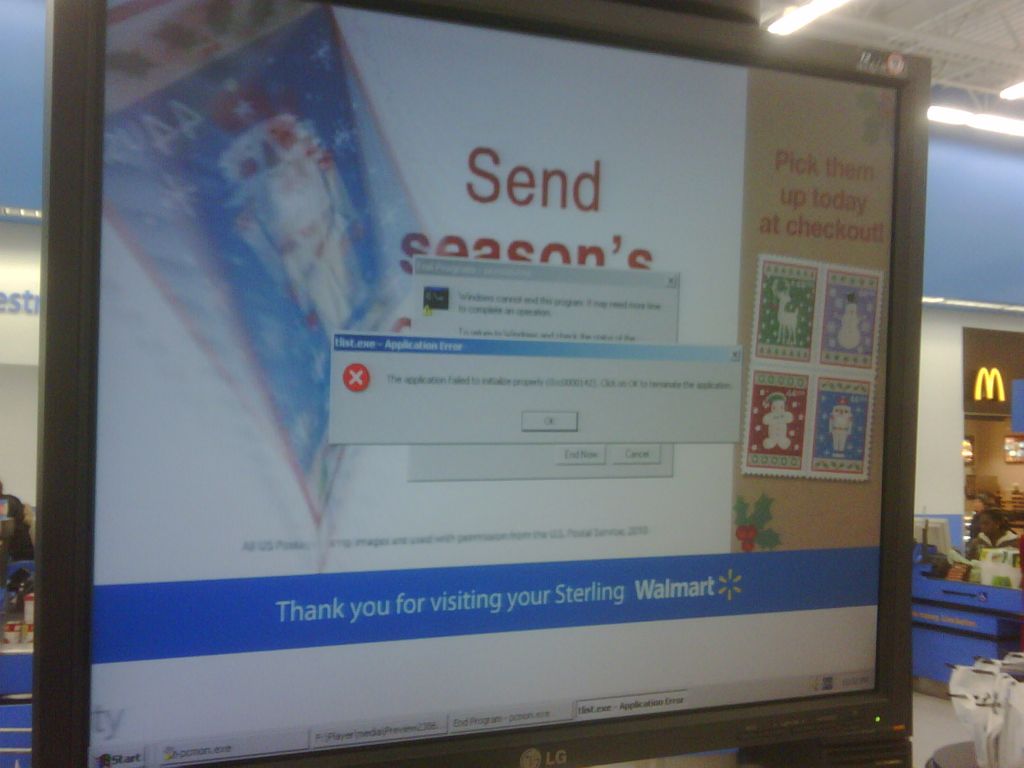
I took a couple of pictures at WalMart before Christmas, and just didn’t get around to posting them. Here they are :-).

First is a helpful Microsoft Windows error displayed on every screen in the store. Second, a magazine that I got a good laugh at: Golf Digest’s cover story on “10 Tips [President] Obama Can Take From Tiger [Woods].” I suspect that ‘cheat on your wife with a cadre of other women’ isn’t one of those tips.

‘The System Worked’ . . . In a Non-Worky Kind of Way

On Christmas day, an Islamic terrorist attempted to detonate an explosive on a flight from Amsterdam to Detroit. Thankfully the attack failed—apparently because the device was flawed, or the terrorist was incompetent, or both—and the plane landed safely and everybody survived.

As is often the case, the terrorist took advantages of weaknesses in our airport security mechanisms. Preliminary information indicates that the terrorists smuggled a liquid explosive onto the plane in his rectum and assembled the device from its innocuous component parts in the airplane bathroom. The attack, however, was entirely preventable. The perpetrator’s father had warned the U.S. government about his son. The explosive being used was easily detectable. Even putting these facts aside, the man was traveling from a county with a major al-Qaeda presence (Yemen) to the United States without luggage—a major, huge, obvious red-flag.

Once the man tried to set off the device, passengers on the plane bravely leaped into action and detained him . . . but the airport security mechanisms in Amsterdam or elsewhere along the line clearly didn’t do what they were supposed to do. Contrary to the claims of many in the Barack Obama (D) administration, the system did not work. The system failed.

I’m not going to condemn Obama or his administration for this. Clearly there is work to do, and Obama has already announced that there will be an investigation and security procedures will be improved. Good. But we’re not stupid; don’t claim the ‘system worked’ when it didn’t!

Scott Bradford is a writer and technologist who has been putting his opinions online since 1995. He believes in three inviolable human rights: life, liberty, and property. He is a Catholic Christian who worships the trinitarian God described in the Nicene Creed. Scott is a husband, nerd, pet lover, and AMC/Jeep enthusiast with a B.S. degree in public administration from George Mason University.