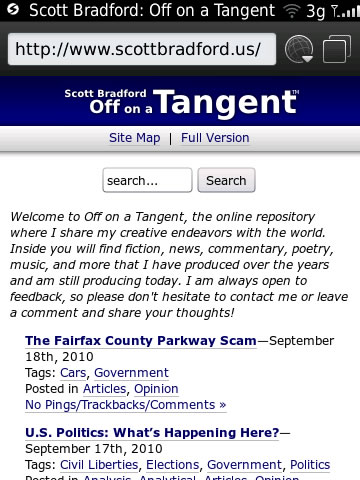
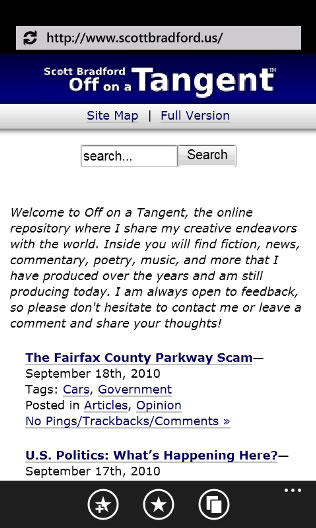
Mobile Browser Support Notes

Finally, the universe of mobile browsers seems to be stabilizing. While there are many mobile platforms out there—iOS, Android, WebOS, BlackBerry OS, Windows Phone, and Symbian—almost all of them are settling on a single browser display engine. All of those platforms except Windows Phone use the WebKit engine, or will soon.

RIM’s BlackBerry OS platform switches to WebKit with version 6, which will be coming out soon for a number of newer BlackBerry phones, leaving Microsoft Windows Phone as the last major holdout. However, this is still great news for web developers. We basically have to support WebKit and the mobile version of Internet Explorer, rather than a multifaceted hodge-podge of proprietary and non-proprietary mobile browsers. To add even broader support, just add Opera Mini and Firefox Mobile too. Those four cover pretty much everybody.

Anyway, the main reason for this entry: BlackBerry OS 6 and Windows Phone 7 are both coming out very soon on new phones (and, in RIM’s case, for some old ones too). Both platforms have completely new browsers. I’m pleased to announce that Off on a Tangent already works in the default browsers for bothof these platforms, and will be officially supported in them moving forward (in addition to the wide support I already offer for most of the platforms listed above).

The Fairfax County Parkway Scam

The first sign of trouble was that there were no signs. After waiting a quarter century to build the last segment of the Fairfax County Parkway (7100), surely they would put up signs when it was done to direct through traffic onto the new highway.

As long as I can remember, signs on route 7100 indicated it ended where it passed underneath Rolling Rd. and turned into the Franconia-Springfield Parkway (7900). You had to perform a number of random turns from there to connect to a separate section of 7100 near Fort Belvoir. It’s been a perennial point of confusion—there were two separate stretches of road labeled as route 7100 that didn’t connect directly to one another. There was a gaping hole, only a couple miles long, and to get around it you had to travel miles out of your way on confusing local roads without clear direction.

The Rolling Rd. interchange was always intended to be the spot at which the two 7100’s would eventually connect; in fact, all of the Rolling Rd. exit signs had ‘7100’ and ‘Fairfax County Parkway’ wording on them, it was just covered up. Those signs were a rare example of forward thinking; they would not need to be replaced when the highway was finally done, they would simply need to have their temporary adhesive coverings removed. The mythical future south-bound traveler on 7100 would need to bear right at the interchange to stay on the highway and proceed toward Ford Belvoir and U.S. 1.

‘Surely this can’t be right,’ I thought, as I approached the 7100 south (née Rolling Rd.) interchange. The signs that should have said 7100 south still didn’t; in fact, the signs still said that 7100 was ending. To much fanfare and local media coverage, the highway had supposedly been finished and opened over a week ago! According to the Washington Post, the ribbon cutting and opening of the last segment of 7100 was scheduled for September 13. There was still work to do on the ‘trubutary’ roads around it, said the Post, but the main thoroughfare would be open. I had decided to go this way today mainly to try out the new connector. ‘Maybe,’ I thought, ‘they just haven’t updated the signs yet.’

U.S. Politics: What’s Happening Here?

The political ‘lay-of-the-land’ in the United States has transformed incredibly in the last three or four years. The pundits and politicos are working themselves into a froth trying to figure out, define, and—yes—control what is happening in this country. All of the old rules seem to be breaking down, with long-time Republican Party insiders finding themselves ousted in the primaries by supposedly ‘radical’ firebrands and seats that have been held by Democrats for decades suddenly in-play and under Republican threat. How did we get here? How did everything change so much and so fast?

There are two main elements at play here, both of which have served to aid the Republican Party in this election cycle though it remains to be seen whether it will continue to do so. The first element is an internal struggle within the Republican Party which has gone on for many years, but has only recently risen to prominence among the outside punditry. The second element is a sea-change, entirely in the last two years, in how the great middle perceives each of our two major political parties.

Republican Party Internal Reform

Despite all the blather over his eight-year presidency, George W. Bush (R) was not the radical right-wing ideologue that his opponents made him out to be. Stinging from Bush’s razor-thin victory over Vice President Al Gore (D) in 2000—a historic election rife with controversy—the political opposition very quickly embarked on an effort to cast the Bush administration as a cabal of hyperactive right-wing psychopaths. The facts simply do not back up this characterization. For example, before the terrorist attacks of September 11, 2001, Bush’s main policy accomplishment was the No Child Left Behind law—a law he crafted with ‘liberal lion’ Senator Ted Kennedy (D-MA) that went on to pass both houses of Congress with broad bipartisan support. Yeah, you’ve got to watch out for those radical right-wing extremists and their bipartisan education bills!

Taking Control from the Carriers

In the United States (and in other places too), our wireless phone carriers have too much control. As an example, I have a Palm Pre Plus that is currently running Palm WebOS 1.4.1. Palm updated the operating system to version 1.4.5 on July 15, which brought a number of new features and capabilities, including support for newer and more-advanced games and applications.

Verizon Wireless, however, has withheld this update from its users. This isn’t unique to Palm users, or Verizon customers. With pretty much every phone other than the iPhone, updated software from phone manufacturers are not released to users until the carriers release them—usually many months late, if they are ever released at all. My old AT&T 8525 (made by HTC) running Windows Mobile was capable of running Windows Mobile 6.5, but AT&T never updated it beyond 6.1. AT&T eventually updated my BlackBerry Bold’s software to BlackBerry OS 5.0, but finally did so many, many months after it became available from RIM (and after I had abandoned AT&T for Verizon anyway).

It’s time to put the control in the hands of the manufacturer of the phone, not the carrier. The company that made my phone has created updated software for it, so let me install it. Verizon has no right to withhold an available software update from me.

Sometimes you can work around these limitations. With BlackBerrys, it’s fairly easy (with the right know-how) to install available software updates on the ‘wrong’ carrier’s phones (during the year+ I had the BlackBerry, I spent most of my time running ‘unofficial’ OS’s that were newer and better than the ‘official’ ones from AT&T). With the old Palm OS phones you could usually hack the ‘unlocked’ versions of the Palm OS onto carrier models. With many Windows and Android phones, vibrant enthusiast communities produce unofficial ‘ROMs’ with updated systems. Sadly there’s no known way (yet) to do this stuff with WebOS because of the uniquely efficient way that Palm packages and distributes its OS updates.

But it’s very simple: we should not have to hack around to run the newest operating systems available for our phones anyway. They are our phones, not Verizon’s or AT&T’s. We should be able to get an updater from the company that made the phone and install it, if we want to, and the carriers should put no roadblocks in our way. Sure, they have the right not to support an unofficial OS version, but they have no right to use technical means to prevent us from installing them if we want to. I’ll say it again: they’re our phones!

Remembering 9/11/2001

I watched the Pentagon burn. First, on the evening of September 11, 2001, I saw the column of smoke rising in the distance as I drove west on Braddock Rd. to visit Melissa in Burke. Then, on September 12, I skipped my classes at George Mason University (which should have been canceled anyway) to drive down to Arlington. I stood, with a fairly large crowd, maybe 350 yards from the collapsed and burning hulk of the building’s western face. I just felt like I had to see it for real, not just as one of the many horrific images on my television.

I drive by the Pentagon now and then, usually on Washington Blvd. which passes right in front of the face that was hit by hijacked American Airlines flight 77. The plane passed so low over the highway that it knocked over some of its overhead street lights. Every time I pass through, I remember standing there and watching the building burn more than 24 hours after the attack. Every time, I think about everything that happened on September 11, 2001. I probably always will.

I’ve talked to people who watched the plane crash into the Pentagon from their offices in Crystal City. Thousands of people saw it from those offices, though from most of them the view of the actual final impact would have been obscured. Many in the Navy barracks and Sheraton Hotel on a hill just west of the Pentagon had a clear view all the way to impact. People driving on Washington Blvd., Interstate 395, and other nearby roads had a clear view as well. They all saw the silver-colored airliner in the standard American Airlines livery slam into the world’s largest office building, killing all 64 passengers and crew (including 5 hijackers) and 125 people in the Pentagon. No conspiracy theories about it being a missile or something, please.

Obviously, the scale of our local tragedy pales in comparison to the carnage in New York, New York, on that same day. The 184 innocent victims in Arlington compare to 2,753 in New York. Another 40 innocent victims died in the crash of United Airlines flight 93 in Shanksville, PA. But the attack on the Pentagon is the one that I saw first hand, albeit a day after. I feel, in some very, very tiny way, that’s ‘my’ part of September 11, 2001.

Another thing that sticks with me is how empty the sky looked over the D.C. metro area in the days that followed. This region has three major airports—Washington Dulles Intl. Airport, Reagan National Airport, and Baltimore-Washington Intl. Airport. There are always planes in the sky. Lots of them. With the national airspace shut down, all the planes were gone. As a long-time resident of this area, and a constant observer of the planes in its busy airspace, it was eerie. You don’t really realize how many of them are there until they’re gone.

There’s a lot more I can say about that day. The absolute, shell-shocked horror on everybody’s faces. The fact that I was supposed to be working downtown in a federal building, but found out about the tragedies unfolding before I left campus. The frustration of dealing with phones that couldn’t make a connection on the overloaded networks when I knew people were worried about me (there had been erroneous reports of car bombs going off in D.C., and my friends and family knew I worked downtown). My parents were supposed to be flying that day (national airspace had been shut down before their flight left). I had woken up late and rushed to a class without checking the morning news, so I missed the early reports about the first plane hitting the Twin Towers in New York.

The more I think about it, the more little details come flowing back almost like it was yesterday.

We have to keep our memories fresh, because the radical Islamic ideologies that led to the September 11, 2001, attacks are still out there and still have their adherents. What happened that day is what happens when these ideologies are brought to their natural conclusions—death and destruction. We have to remember, and we have to constantly dedicate ourselves to fighting radical Islam because, if we don’t, there’s no reason that September 11, 2001, can’t happen again.

God bless you, and God bless America.

Scott Bradford is a writer and technologist who has been putting his opinions online since 1995. He believes in three inviolable human rights: life, liberty, and property. He is a Catholic Christian who worships the trinitarian God described in the Nicene Creed. Scott is a husband, nerd, pet lover, and AMC/Jeep enthusiast with a B.S. degree in public administration from George Mason University.