
Citizens of Virginia will be voting on three proposed constitutional amendments this year. This endorsement article considers only the first, which is especially important and deserves extra attention and analysis. An endorsement article addressing the second and third will be published separately.
There are two methods for amending the Constitution of Virginia described in Article XII. This one comes to us through the Section 1 method, which is most commonly used: The proposal is passed by both houses of the General Assembly, and then, after an intervening House of Delegates election, passed again, then presented to the voters in a referendum.
Human Rights
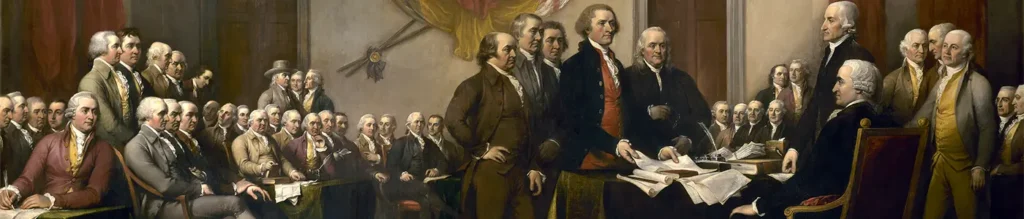
We hold these truths to be self-evident, that all men are created equal, that they are endowed by their creator with certain unalienable rights, that among these are life, liberty, and the pursuit of happiness. That to secure these rights, governments are instituted among men, deriving their just powers from the consent of the governed.
– United States Declaration of Independence
There are three fundamental human rights: life, liberty, and property. These exist under natural law; governments did not create them and cannot overrule them. In fact, the purpose of governments—the whole reason they exist—is to protect and defend these rights from all encroachments, except to the least extent necessary to protect the rights of others.
The order of these rights expresses their priority. Someone’s true and legitimate property rights may be limited when necessary to protect someone else’s life or liberty, and someone’s liberty rights may be limited when necessary to protect another’s life. “Life” is listed first because it is the first right. It is the prerequisite for, and basis of, all other rights. A human life may only be taken when one person’s right to life is in direct conflict with another’s—like cases of legitimate self-defense or just war.
Nations do not always live up to these standards; when they fall short, they inevitably harm themselves. The people suffer immensely, the ties of community and brotherhood dissolve, the culture weakens. If it stubbornly persists in its violations, the whole rotten thing will eventually collapse into civil war, coups, and chaos. The new governments and social structures that emerge from the wreckage may be better . . . or may be worse.
Virginia’s Failure
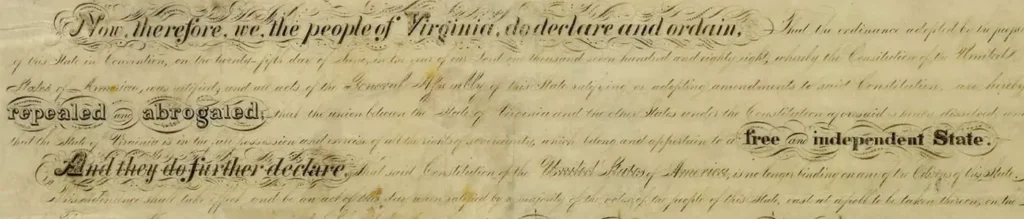
On April 17, 1861, a state convention convened by the Virginia General Assembly adopted the Virginia Ordinance of Secession. It claimed that the U.S. federal government had “perverted [its] powers not only to the injury of the people of Virginia, but to the oppression of the southern slave-holding states,” and that, if the voters confirmed the ordinance in a referendum, Virginia’s original ratification of the U.S. Constitution would be “repealed and abrogated.” The referendum passed. Virginia seceded from the Union, joined the rebellion, became the capital of the Confederate States of America, and was eventually defeated in the bloody war that followed.
As I have said before, “The American Civil War was about more than just slavery. Southern apologists are right when they say that it was about states’ rights. But northern apologists are right, too, when they point out that the main ‘right’ the rebels were defending was the ‘right’ to treat human beings as property, which was no right at all.”
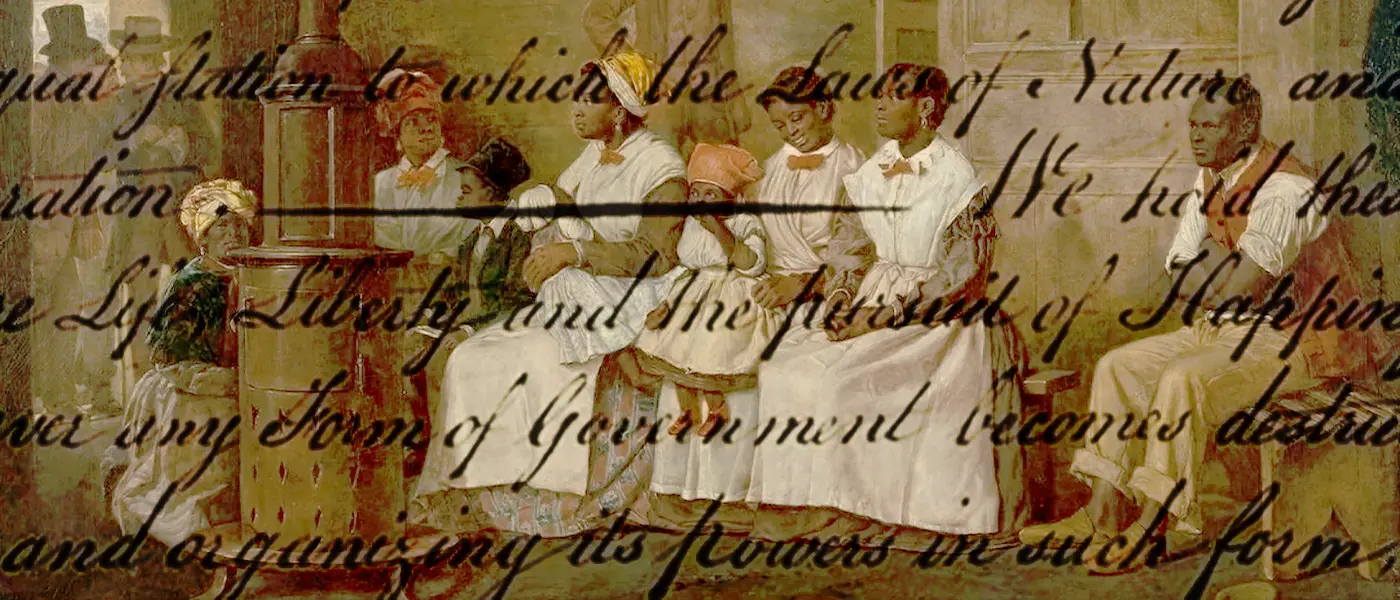
Slavery is a stain on American history . . . especially in the states, like our own, that were willing to rip our union apart to defend it. Its supporters cloaked the institution in the rhetoric of rights; that was a perverse inversion of reality. Elevating slaveholders’ property rights above slaves’ liberty rights was evil. Everyone who voted “yes” in that 1861 referendum—whatever their intent and however they rationalized it—is rightly condemned by history.
The referendum we’re considering today also comes cloaked in the rhetoric of rights; it too is a perverse inversion of reality. Elevating mothers’ liberty rights above their unborn children’s right to live is an even greater evil than the one our state endorsed 165 years ago. And everyone who votes “yes”—whatever their intent and however they rationalize it—will also be condemned by history.
The Question
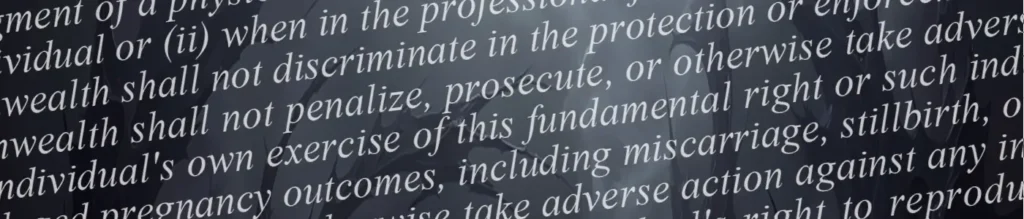
Virginia’s Question 1 appears on the ballot as follows:
Should the Constitution of Virginia be amended to (i) protect the freedom to make personal decisions about prenatal care, childbirth, postpartum care, birth control, abortion, miscarriage management, and fertility care; (ii) protect doctors, nurses, and patients from being punished for these decisions; and (iii) allow for restrictions on access to abortion during the third trimester of pregnancy except when the patient’s health is at risk or the pregnancy cannot survive?
This description is nearly as dishonest and misleading as the one that appeared on an unconstitutional referendum attempt earlier this year. On its face it seems pretty reasonable; of course people should be free to make their own personal medical and reproductive decisions. It also seems to take a compromise position on abortion, allowing for widely-supported restrictions in the third trimester except in certain limited cases. But after what happened with that earlier referendum, we know we cannot trust these summaries; we must carefully examine the proposed amendment itself.
The text that would be added to our state’s Bill of Rights would assert a “fundamental right to reproductive freedom” that “shall not be, directly or indirectly, denied, burdened, or infringed upon unless justified by a compelling state interest achieved by the least restrictive means.” Protecting human life would be a “compelling state interest” under the normal meaning of the term in law and precedent . . . but four paragraphs later, where the authors hoped we wouldn’t look, they redefine the phrase: “For the purposes of this section, a state interest is compelling only if it is for the limited purpose of maintaining or improving the health of an individual seeking care, consistent with accepted clinical standards of care and evidence-based medicine, and does not infringe on that individual’s autonomous decision making.”
This prohibits any consideration of the child’s rights. The mother’s “autonomous decision making”—a liberty right—would be given improper priority over the child’s higher right to live. In essence, it declares that some people are not people at all. That would violate articles VI and VII of the Universal Declaration of Human Rights: “Everyone has the right to recognition everywhere as a person before the law,” and, “All are equal before the law and are entitled without any discrimination to equal protection of the law.” It would be a literal crime against humanity.
The third-trimester exception is also deeply flawed. It allows restrictions on late-term abortions except in cases where a physician determines it is necessary “to protect the life or physical or mental health of the pregnant individual” or “the fetus is not viable.”
In the extremely rare case where continuing a pregnancy is a direct threat to the mother’s life, a doctor can end the pregnancy, but is required under natural law and the physician’s oath (“do no harm”) to make every reasonable effort to save both mother and child. If that happens, but the child does not survive, there was no abortion. The child was not intentionally killed. Even if abortions were completely outlawed, this scenario would not be affected. The amendment’s authors are trying to muddle the issue by implying that there are medically necessary abortions. There is no such thing. They are lying.
The other cases—to protect the mother’s “physical or mental health” or when “the fetus is not viable”—cannot justify terminating a pregnancy. If the mother’s life is not directly threatened, the child’s right to live takes precedence. The “mental health” exception is obviously included as a convenient (but backhanded and dishonest) path for circumventing restrictions. And the “viability” exception is just horrific; you can’t kill someone because you think they’re probably going to die soon anyway. I suspect you’d face murder charges if you tried putting that philosophy in action at your local hospice facility. It may acceptable in some circumstances to let someone die by withdrawing supportive care; it is never acceptable to kill them.
Virginia already fails to protect the rights of the unborn. Passing this amendment doesn’t allow any new injustices, and rejecting it won’t stop any old ones. Our most vulnerable neighbors are legal nonpersons, and abortion will remain almost completely unrestricted for now. It would still be a terrible thing to put this abject denial of human rights into the very document that is supposed to declare and uphold them. The first thing to do when you’re stuck in a hole is stop digging.
Our Crisis
The United States is in a moral crisis. Our soul is sick. You must see it. Many of our neighbors are broken, disconnected, angry, and irrational. They seem possessed with an unshakeable belief that angels are devils, and devils are angels. They openly praise assassins who shoot at politicians, public speakers, and corporate executives. They rally in support of genocidal Islamist terrorists while shouting antisemitic catch-phrases and insisting that victims are perpetrators and perpetrators are victims.
As I write this article, some Americans are publicly supporting a mother who strangled her three children to death. Eleven of her twelve jurors wanted to acquit; God bless the lonely, stubborn holdout who prevented that injustice. I understand having some sympathy for Lindsay Clancy, an overwhelmed mom facing mental health struggles. I can’t understand the lack of sympathy for five-year old Cora, three-year old Dawson, and eight-month old Callan. What about their mental health struggles as their mother squeezed the life out of them? Didn’t they matter? Don’t they deserve justice?
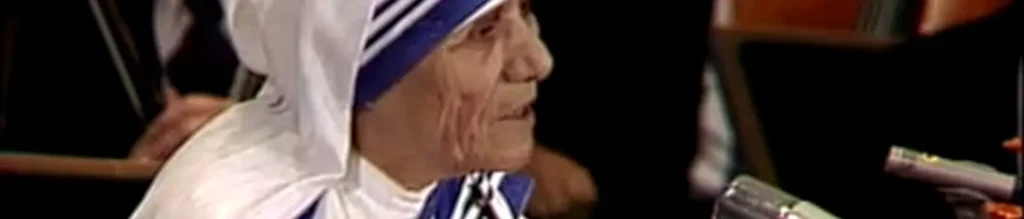
This all seems incomprehensible, but we should have seen it coming. Mother Theresa—now Saint Theresa of Calcutta—warned us. As she accepted the Nobel Peace Prize in 1979, she said, “If a mother can murder her own child in her own womb, what is left for you and for me [but] to kill each other?” You do not have to be Catholic—or any other kind of Christian—to see that she was right. Dehumanization begets dehumanization. If one class of people is worthless, why not another? And another? Before long, there are no humans left. Those who are targeted by hate lose their humanity by decree; the haters lose theirs by choosing to be inhuman.
Conclusion


Things looked similarly bleak in the nineteenth century. As our nation ran headlong toward the Civil War, the rot at its core was chattel slavery. The bilious poison of that institution also surfaced in political attacks, social violence, and morally bankrupt rhetoric. In the 1861 referendum, Virginia’s legislators asked the voters to recommit to a self-destructive injustice. They did. It cost them, and the whole nation, dearly.
Slavery was already embedded in Virginia’s soul. If the secession referendum had failed, it would not have changed anything overnight. But passing it served as a public declaration that we were not going to change our ways easily—that we were so numb to the truth, so blinded by self-interest, that we would do almost anything to avoid admitting we were wrong . . . even if it meant tearing our own state to bloody pieces, and taking the rest of the nation with us.
The bilious, poisonous rot in Virginia’s soul today is the institution of abortion. Our legislators are asking us to declare, once again, that we will not change our ways. They want us to demonstrate that we are as numb, as blind, as hate-filled as our forbears were 165 years ago. If we do, it will be no less shameful . . . and, sooner or later, it will cost us just as dearly.
Virginians, I beg you: Vote NO on Question 1.